
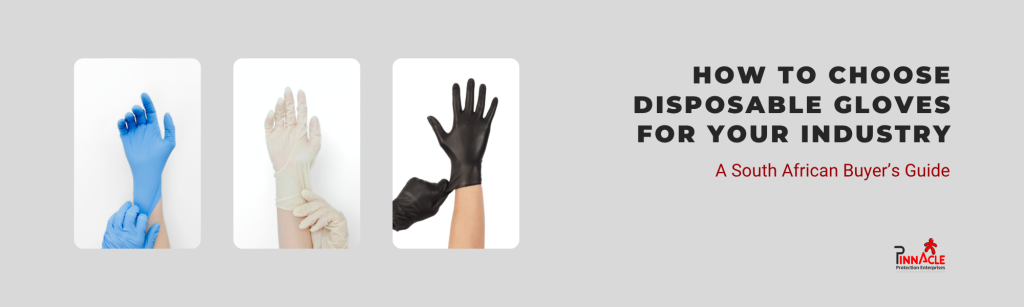
Disposable gloves should be selected on the basis of the hazard, the task, the length of exposure and the dexterity the job requires. No single glove protects against everything. A glove suited to a hospital ward will not perform in a chemical washdown, and a glove built for heavy-duty cleaning is the wrong tool for precision laboratory work.
This guide sets out how procurement and safety teams in South Africa should approach glove selection across healthcare, food processing, pharmaceutical, industrial and cleaning environments, and which questions to ask a supplier before placing an order.
How do you choose the right disposable glove?
Work through five questions in order:
- What is the hazard? Chemical, biological, physical, or general contamination control.
- What is the task? What the worker is actually doing while wearing the glove.
- How long is the exposure? Brief contact and continuous immersion are different problems.
- What dexterity is needed? Fine handling and heavy scrubbing call for different constructions.
- What documentation exists? Ask for the product data sheet, not the product name.
Everything else, including price, follows from those answers.
What hazard are you protecting against?
Start with the risk, not the catalogue. In a typical workplace, hands may be exposed to biological contaminants, chemicals, oils and liquids, general soiling, abrasion, sharp objects, cleaning agents, food products, or pharmaceutical materials. Each of those calls for a different level and type of barrier.
Three international standards define what a glove must demonstrate:
- ISO 374-1:2024 sets terminology and performance requirements for gloves protecting against dangerous chemicals. It was published in July 2024 as the second edition, replacing ISO 374-1:2016.
- ISO 374-5:2024 covers gloves intended to protect against micro-organisms, also published in July 2024.
- ISO 374-2:2019 covers penetration resistance, which underpins claims made under Part 5.
One caveat matters more than the standards themselves. A standard describes what a glove must achieve to carry a specific claim. It says nothing about a glove that has not been tested against it. Before relying on any chemical or micro-organism protection claim, request the product data sheet and check what it states for that specific product and for the chemicals your team actually handles.
In South Africa, the legal duty sits with the employer. Section 8 of the Occupational Health and Safety Act 85 of 1993 requires every employer to provide and maintain, as far as is reasonably practicable, a working environment that is safe and without risk to the health of employees. The General Safety Regulations under the Act add that employers must supply necessary personal protective equipment free of charge, keep it clean and in good condition, keep it available on the premises, and train employees in its proper use.
Which disposable gloves are used in healthcare environments?
Examination gloves are the standard choice for healthcare, where the risk is exposure to blood, body fluids, contaminated surfaces and infectious material.
Gloves do not replace hand hygiene, and this is where practice often slips. Wearing gloves for tasks that do not require them, or failing to change them at the right moment, spreads contamination instead of containing it.
For healthcare procurement, four questions are worth asking:
- Are the right gloves stocked for the right procedures, or is one glove doing every job?
- Is the full size range available so staff can achieve a proper fit?
- Are staff trained on when to change gloves, not only on how to put them on?
- Does glove use sit alongside hand hygiene protocol, or has it quietly replaced it?
Pinnacle’s healthcare range:
| Product | Material | Key specification | Sizes |
|---|---|---|---|
| Blue Nitrile Examination Gloves | 100% synthetic nitrile, latex-free | Powder-free, polymer coated, finger textured, beaded cuff, 5-year shelf life | XS to XL |
| Latex Examination Gloves, Powder Free | Natural rubber latex | Non-sterile, high tactile sensitivity | XS to XL |
| Latex Examination Gloves, Powdered | Natural rubber latex | Non-sterile, easy donning | XS to XL |
The nitrile examination gloves are manufactured to ASTM D6319 dimensional and physical property requirements, with a minimum length of 240 mm and minimum tensile strength of 14 MPa. They are supplied 100 per dispenser and 1,000 per carton.
Which disposable gloves are used in food processing and food handling?
Two products in Pinnacle’s range are supplied for food environments: Green Nitrile Chemical Gloves and Blue Nitrile Examination Gloves. The green nitrile glove is the heavier-duty option for washdown, sanitation and chemical handling in food plants. The blue nitrile examination glove suits lighter handling tasks where dexterity matters more than durability.
Latex household gloves, including the yellow and the blue Superior, are not supplied for food handling. They are cleaning and general-purpose gloves. If your team is currently using them for food contact tasks, that is worth reviewing.
Gloves alone do not make a food operation hygienic. A glove that is not changed between tasks becomes a contamination route of its own. Most food processing sites need a complete disposable PPE system:
- Gloves appropriate to the task
- Mop caps or hairnets
- Beard covers
- Face masks where the process requires them
- Disposable aprons
- Shoe covers
- Coveralls or lab coats in higher-risk areas
Suitability should always be confirmed against the product documentation and your own HACCP or food safety plan.
What should pharmaceutical and laboratory buyers consider?
In pharmaceutical manufacturing and laboratory settings, gloves do two jobs at once. They protect the worker, and they help stop contamination from people, clothing and the surrounding environment entering a controlled process.
That makes consistency of supply carry as much weight as the specification. A substitution that looks harmless on a purchase order can create real problems on the floor. A different fit changes how staff don and remove gloves. A different material changes tactile feedback. A different batch profile can force requalification.
Practical considerations for controlled environments:
- Material, and whether it is latex-free
- Powder-free construction to limit particulate
- Consistent fit across the size range
- Documented change frequency and donning protocol
- Storage conditions and shelf life
- Whether the supplier holds stock or substitutes mid-contract
Pinnacle’s nitrile examination gloves are powder-free and polymer coated, with a five-year shelf life when stored in dry conditions away from direct sunlight.
Which gloves suit industrial and cleaning work?
Industrial and contract cleaning environments vary more than any other category. A worker handling general materials has a different requirement from someone diluting and applying cleaning chemicals or working with hot water.
OSHA is direct on this point in its PPE guidance. No glove protects against every potential hand hazard, commonly available glove materials give only limited protection against many chemicals, and most materials will eventually be permeated by the chemicals they contact. Its selection guidance lists the area requiring protection, grip requirements in dry, wet and oily conditions, thermal protection, and size and comfort as the factors to weigh.
The common procurement mistake is choosing a glove by appearance or price instead of by what it is built to resist.
Pinnacle’s industrial and cleaning range:
| Product | Built for | Construction |
|---|---|---|
| Green Nitrile Chemical Gloves | Chemical handling, heavy-duty cleaning, wet and dry work, hotter water | Flock-lined nitrile, gauntlet elbow-length cuff, diamond-pattern palm, winged thumb, sizes 8 to 10 |
| Black Nitrile Examination Gloves | Automotive, tattoo, general industrial | Powder-free nitrile, finger textured, beaded cuff |
| Yellow Latex Household Gloves | General cleaning, repetitive wet and dry tasks | Cotton flock lined, extra long rolled cuff, fluted cuff, embossed palm |
| Blue Latex Household Gloves, Superior | Hygiene-sensitive cleaning, longer shifts | Powder-free, flock-free, polymer coated and chlorinated, ASTM D4679 |
The green nitrile glove is supplied one pair per packet, 240 pairs per carton, and holds its physical properties for up to 18 months when stored correctly in a cool, dry place away from humidity.
Nitrile or latex: which is better?
Neither material wins outright. The right answer depends on the application, the wearer and the exposure.
| Consideration | Nitrile | Latex |
|---|---|---|
| Material | Synthetic rubber, latex-free | Natural rubber |
| Chemical resistance | Broader range | Narrower range |
| Puncture resistance | Higher | Lower |
| Elasticity and tactile feel | Good | Excellent |
| Allergy risk | No natural rubber latex proteins | Natural rubber latex allergy risk |
| Typical use | Healthcare, food, laboratory, chemical, industrial | Examination, dental, general cleaning |
| Pinnacle products | Blue and Black Nitrile Examination, Green Nitrile Chemical | Latex Examination powdered and powder-free, Yellow and Blue Latex Household |
The deciding factor is often the workforce rather than the task. Natural rubber latex sensitivity develops with repeated exposure, so a site with a rotating team and no nitrile option has nothing to fall back on when a worker becomes sensitised.
Does glove size and fit actually matter?
Yes, and the consequences are operational.
A glove that is too large reduces dexterity and catches on equipment. A glove that is too small restricts movement, tears more easily and becomes uncomfortable enough that workers take it off. Both push staff towards adjusting, replacing or skipping PPE.
Stocking the full size range adds to inventory. It also cuts tears, reduces glove changes and makes compliance easier to enforce, which is usually the cheaper outcome.
How should you compare disposable glove costs?
Compare cost per task, not cost per box.
A cheaper glove that tears more often, needs changing more frequently, reduces dexterity or is wrong for the application will erase its own saving quickly. The better procurement question is what level of protection and performance you are getting for the total cost, including labour time lost to glove failures and the risk carried if the glove is not suited to the work.
Disposable glove selection checklist
Before placing your next order:
| ✓ | Procurement Check | Sector Relevance |
|---|---|---|
| ☐ | Has the hazard been identified: chemical, biological, physical, contamination or general hygiene? | All sectors |
| ☐ | Has the task been defined, covering what the worker will actually be doing while wearing the glove? | All sectors |
| ☐ | Is the exposure duration known, and does the glove suit brief contact or prolonged contact? | All sectors |
| ☐ | Does the glove provide the dexterity the work requires, whether precision handling or heavy-duty work? | All sectors |
| ☐ | Has the supplier provided a product data sheet for this specific product? | All sectors |
| ☐ | Does the documentation confirm the material, and whether the glove is latex-free? | Healthcare, food, pharmaceutical |
| ☐ | If a chemical or micro-organism protection claim is being relied on, is it stated in the product documentation? | Industrial, cleaning, healthcare |
| ☐ | Has chemical compatibility been confirmed for the specific substances your team handles? | Industrial, cleaning, food |
| ☐ | Is powder-free construction confirmed where particulate control matters? | Pharmaceutical, laboratory, healthcare |
| ☐ | Is suitability for food handling confirmed against the data sheet and your food safety plan? | Food processing |
| ☐ | Is the full size range available so every worker can achieve a proper fit? | All sectors |
| ☐ | Is the shelf life and storage requirement confirmed on the packaging or data sheet? | All sectors |
| ☐ | Does the glove work alongside the rest of the PPE system: caps, masks, aprons and coveralls? | Food, pharmaceutical, healthcare |
| ☐ | Can the supplier demonstrate consistent stock availability at your required volume? | All sectors |
| ☐ | Has your QA or safety team reviewed the documentation and confirmed product suitability? | Pharmaceutical, healthcare |
Frequently Asked Questions
What is the difference between examination gloves and chemical gloves?
Are nitrile gloves better than latex gloves?
Which disposable gloves can be used for food handling?
How long do disposable gloves last in storage?
What does ISO 374 cover?
Who is legally responsible for providing PPE in South Africa?
Should powdered or powder-free gloves be used?
How do I request a glove data sheet from Pinnacle Protection Enterprises?
Buying disposable gloves in South Africa
Pinnacle Protection Enterprises has supplied disposable PPE to healthcare, food processing, pharmaceutical, industrial and cleaning businesses across South Africa for over 20 years, as a direct importer, manufacturer and distributor. Alongside product supply, Pinnacle offers training, auditing and advisory support for businesses building or reviewing a PPE programme.
There are two ways to move forward.
Order online. The Pinnacle online store is live. Browse the full disposable glove range, check pack and carton quantities, and place your order directly.
Ask first. If you are unsure which glove suits a specific process, chemical or environment, send the Pinnacle team the detail. They will work through it with you and share the relevant product data sheet before you commit to an order.
Shop the disposable glove range at pinnacleppe.com
Pinnacle Protection Enterprises 62 Trump Street, Selby, Johannesburg +27 11 493 9511 info@pinnacleppe.com