
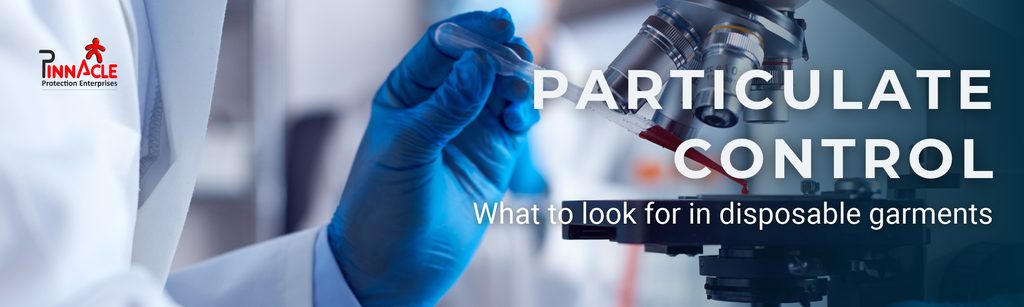
In a pharmaceutical or laboratory area, people are a constant source of particles. Skin flakes, hair, clothing fibres and glove powder can all end up in a product or a sample. Particulate control garments keep that material contained, so choosing them comes down to what each garment sheds, what it covers and what its data sheet confirms.
The labels don’t always help. Lint-free, low-linting and powder-free describe different things, and a product can carry one without the others. This guide explains what each term tells you, which Pinnacle garments suit which areas, and what to check before you order.
Why Particulate Control Garments Matter in Pharma and Lab Work
Contamination runs in two directions in these environments, and the garment has a job in both.
Protecting the product from the operator. Hair, skin and fibres from everyday clothing settle on open product, equipment and samples. A garment that sheds little and covers street clothes, hair and footwear reduces what reaches the work surface.
Protecting the operator from the product. Powders, liquids and splashes from the process can reach the wearer. Here the barrier matters: how well the fabric keeps liquid out, and how fully the garment closes at the wrists, ankles and neck.
Most sites need both. That is why particulate control garments are usually specified as a set: body cover, head and beard covers, sleeves, shoe covers and gloves.
Lint-Free vs Low-Linting: What the Label Tells You
Lint is the loose fibre a fabric releases as it is worn, folded and moved. The terms on a product sheet describe how much of it to expect.
| Term | What it describes | What it doesn’t tell you |
|---|---|---|
| Lint-free | A fabric the manufacturer describes as not releasing lint | Whether the garment suits a graded cleanroom |
| Low-linting | A fabric that releases little lint | How it compares with a lint-free fabric in your process |
| Powder-free | A glove made without added powder | Anything about the garments worn with it |
Treat each term as the start of your specification. The data sheet for each product holds the full detail.
Microtex Coveralls: Lint-Free, Full-Body Cover
Pinnacle’s Microtex disposable coverall is made from 50 g/m² PP/PE microporous material. The fabric is lint-free and waterproof, and it is air-permeable, which makes it more comfortable over a long shift.
It closes fully, with a hood, zip guard and elastic at the wrists, waist and ankles. For particulate control, that closure is what contains the wearer’s own clothing and hair.
The online store lists sizes M to XXL, sold singly or in cartons of 50.
Nonwoven Lab Coats: Low-Linting, Lighter Cover
Pinnacle’s disposable non-woven lab coat is 30gsm spunbond nonwoven and described as low-linting. It has elastic wrists, a single collar, velcro fastening and no pocket. The online store lists sizes M to XXXL.
The lab coat is flammable. Keep it away from open flames, sparks and combustible liquids, which matters at any bench with a burner.
Coverall or Lab Coat: Which Suits Which Area?
The choice comes down to how much of the wearer needs covering and whether liquid is involved.
Choose the Microtex coverall where clothing, hair and footwear must be fully contained, where there is a splash risk, or where product is exposed for long periods. Dispensing, production and cleaning of process equipment often fall here.
Choose the lab coat for lighter bench work, quality control testing and visitors, where your procedure allows a coat over clothing and liquid exposure is low.
If you’re unsure, start from your site’s gowning procedure, which should say which areas need full-body cover. For a wider comparison of coverall types, read our guide to nonwoven, Microtex and Type 5/6 coveralls.
Particulate Control Garments Beyond the Coverall
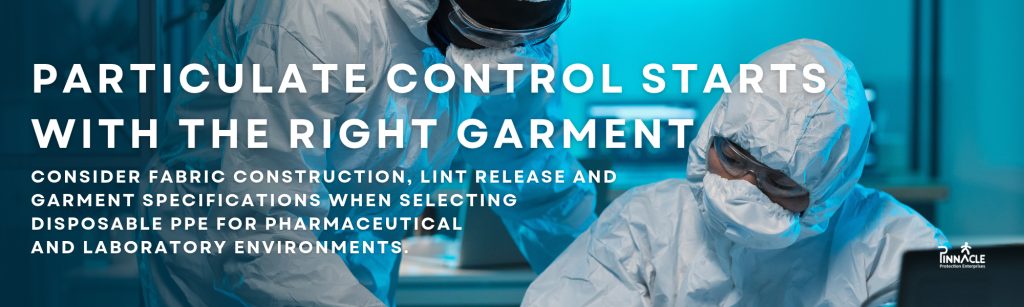
Body cover deals with the largest surface. A full set of particulate control garments also closes the gaps at the hair, arms and feet.
- Mop caps: nonwoven polypropylene in 18, 21 and 24 inch sizes and eight colours. The colours can separate areas or teams.
- Beard covers: spunbond polypropylene with a single elastic head loop, one size. They are easy to leave off a specification, so list them by name.
- Sleeve protectors: 20 micron polyethylene, 18 inch, latex-free, with elastic at the shoulder and wrist. They protect against non-hazardous liquid splash, spray and dry particulates, and work well over a lab coat when forearms reach into the work.
- Shoe covers: nonwoven covers are breathable but give no liquid protection. PE covers are waterproof, with heat-sealed seams and a lint-free finish, in 20 or 30 micron.
Why Powder-Free Gloves Are the Baseline
Glove powder is itself a particle. Once it is on a glove, it transfers to everything the wearer touches. In pharmaceutical and laboratory areas, powder-free is therefore the starting requirement for gloves.
Pinnacle’s blue nitrile examination gloves are powder-free and latex-free, with a finger-textured finish and a beaded cuff. Black nitrile is also available. Sizes S to XL are held in stock, and XS can be ordered on special request.
How to Specify Particulate Control Garments
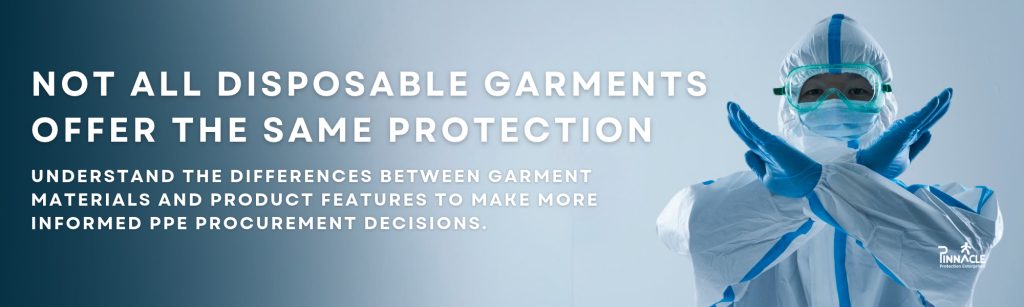
A written specification for particulate control garments keeps orders consistent between buyers, departments and deliveries. Cover these five points.
- The area and the task. Name where the garment is worn and what the wearer does there, such as dispensing, sampling, testing or cleaning.
- The fabric. State lint-free or low-linting, and whether you need waterproof protection.
- The full set. List body cover, head and beard covers, sleeves, shoe covers and gloves together, so nobody improvises on the day.
- The documentation. File the data sheet for each product with the specification.
- Substitutions. Agree that any replacement is checked against the specification before it is accepted. Similar product names don’t mean similar fabrics.
If your area has a cleanroom classification, specify garments against your own gowning procedure and check each data sheet before you order.
For more on keeping purchasing consistent, read How to Build a PPE Programme That Actually Works.
Before you order, download the data sheets from the Microtex coverall and lab coat product pages and check them against your procedure.
Frequently Asked Questions
Where Do I Find Data Sheets for Particulate Control Garments?
Open the product page and select Download Data Sheet. Each sheet carries the full technical specification and the donning and removal instructions, which are useful when you write or update a gowning procedure.
Can I Request Samples of Particulate Control Garments Before Ordering?
Yes. Each product page has a Request a Sample form, so you can check fit and fabric with your team before placing a bulk order.
Can I Order Sizes That Aren’t Listed on the Online Store?
The store shows the sizes Pinnacle keeps in stock. Other sizes listed on a product’s data sheet can be ordered on special request. Contact the team to check availability and lead time.
How Quickly Are Orders Delivered?
Pinnacle delivers nationwide through The Courier Guy. Orders in Gauteng usually arrive in 1 to 2 business days, and major centres elsewhere in 2 to 4. The minimum order value is R500 including VAT.
About Pinnacle Protection Enterprises
Pinnacle Protection Enterprises is a South African importer, manufacturer and distributor of disposable PPE and hygiene consumables, trading for over 20 years from Selby, Johannesburg. Products carry ISO 13485, CE marking and SABS/NRCS homologation where applicable, and each batch is inspected before dispatch.
Contact the Pinnacle team to talk through a specification for your site.