
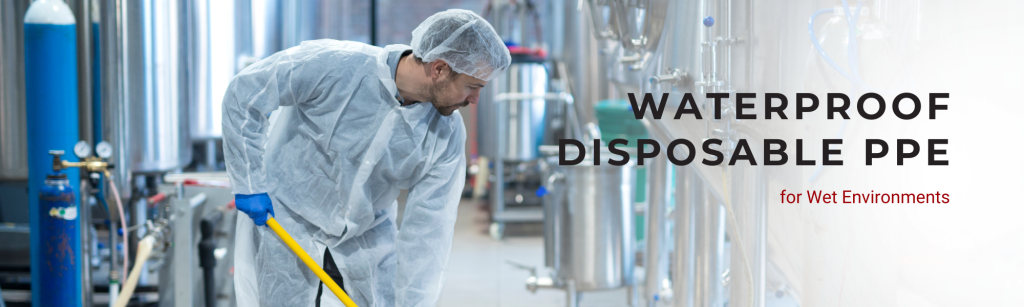
Most disposable PPE is specified for particles. Dust, fibres, splashes of the light and occasional kind. Then it gets issued into a wet environment, and the assumptions stop holding.
Washdown areas, dairy and beverage plants, poultry processing, chemical dosing, high-pressure cleaning. In all of these, the water is not incidental. It is a constant, and it changes what the PPE has to do.
The problem is that “disposable coverall” and “disposable shoe cover” both describe several very different products. Two items can look almost identical in a catalogue and behave completely differently the first time someone stands in a wet aisle.
Breathable and waterproof are not the same thing
Three material types dominate disposable PPE, and only two of them hold out liquid.
Spunbond nonwoven polypropylene. Light, breathable, low-linting. Standard for disposable lab coats and basic shoe covers. It is a particle barrier. Put it in front of a hose and it wets through.
Microporous PP/PE film. A polypropylene layer bonded to a polyethylene film. Pinnacle’s Microtex coverall is 50g/m2 in this construction, PP30g plus PE20g, and it is waterproof while still being air-permeable. That combination is the reason it works for washdown: the wearer stays dry without cooking inside the suit across a full shift.
Polyethylene film. LDPE aprons, PE shoe covers, PE sleeve protectors. No breathability, complete liquid barrier. The right answer when the task is short, wet and messy.
A useful shorthand: nonwoven keeps particles off, film keeps liquid out. If your risk assessment says liquid and your stock cupboard says spunbond, you have a gap.
What goes wrong when the specification is loose
Wet-through PPE fails quietly. Nobody logs an incident. What happens instead:
- Staff double up, wearing two coveralls or two pairs of shoe covers to compensate. Consumption climbs and nobody connects it to the specification.
- Items get changed out mid-shift rather than at shift end, which quietly doubles the line item.
- Compliance drops. People stop wearing what is uncomfortable, particularly non-breathable film garments issued for long shifts where a microporous option would have been the better call.
- Wet floors and smooth-soled covers combine badly.
Each of these looks like a cost problem or a behaviour problem. Usually it is a specification problem.
Specifying for wet work, by body area
Body. For sustained wet work, a microporous coverall is the practical baseline. Pinnacle’s Microtex coverall carries a zip guard, hood, and elastic at wrist, waist and ankle, which matters more in wet conditions than dry: open cuffs channel water inside the garment. If you are weighing nonwoven against microporous more generally, our guide to disposable coveralls covers the full comparison. Nonwoven coveralls with a bonded PE film offer a lighter alternative at 35g/m2. A plain spunbond lab coat is a poor choice near water and should be reserved for dry particle work.
Front-of-body splash. An LDPE apron over a coverall is cheaper than replacing a wet-through coverall. The disposable plastic apron is waterproof, oil proof and dust proof, and covers chest to legs. It is not the item for heavy oils, flames or work with high abrasion or tear risk.
Arms. Where the task is reaching into tanks, sinks or wash bays, a polyethylene sleeve protector at 20 micron handles non-hazardous liquid splash and spray without committing to a full coverall.
Feet. This is where the difference is starkest. A nonwoven shoe cover is breathable and offers no liquid protection. A PE shoe cover at 20 or 30 micron is completely waterproof with heat-sealed seams, suited to light duty. The CPE/PPE deluxe cover pairs a CPE upper with a nonwoven sole and an anti-skid finish, which is the sensible option where wet floors are the concern rather than water ingress alone.
Hands. Wet work is different from examination work. A flock-lined nitrile chemical glove with a gauntlet elbow-length cuff is built for wet and dry handling, tolerates hotter water than a thin examination glove, and suits heavy-duty cleaning and chemical contact. The cuff length is the point: it stops water running down the forearm when hands are raised. Our guide to choosing disposable gloves covers sizing and material selection in more detail.
A specification check before the next order
Five questions worth putting to whoever raises the requisition:
- Is the exposure splash, spray, immersion, or standing water? Each points to a different item.
- How long is the shift in the garment? Over about four hours, breathability stops being a comfort question and starts being a compliance question.
- Is the floor wet as well as the work? If yes, sole grip belongs in the specification.
- What chemicals are in the water? Detergents and sanitisers at temperature are harder on a glove than plain water.
- Are people doubling up on any item? That is your signal that something is under-specified.
If you are working to HACCP requirements, our HACCP PPE Guide sets out how PPE selection fits into a wider hygiene plan.
Where this matters most
Food and beverage processing, dairy, poultry, commercial laundries, industrial cleaning contractors and chemical dosing areas all run wet by design. In each, PPE is doing two jobs at once: protecting the worker and protecting the product from the worker.
Getting the material right is the cheapest part of that. It costs nothing extra to specify a film shoe cover instead of a nonwoven one. It costs a great deal to discover the difference through consumption creep and dropped compliance.
If you are unsure which specification fits a particular area, send us the task and the exposure and we will talk you through the options in the range. Send an enquiry and we will come back with a recommendation and pricing.